

The Truth About Pinterest Keywords for Pins and Boards
I suddenly feel like we’re going back to basics, and honestly, I’m all for it. Most people think that Pinterest SEO just means putting the keywords everywhere and hoping for the best. But the truth about Pinterest keywords is it’s not just your board titles or your pin titles. It’s not where you place your keywords so much as the intention behind it.
Where Pinterest keywords differ across the platform
We’re going to talk today in some depth about Pinterest SEO, boards and pins, and what matters with Pinterest keywords. Because if you don’t really understand the difference, you’re going to end up with boards full of pins that go nowhere, and that’s not what you want.
By the end of this post, you should walk away knowing the difference between board SEO, pin SEO, truly the difference between both of them. So let’s dig in. I’m going to be using an example of a small business that creates and sells teas, and markets on Pinterest.
RELATED: Pinterest SEO Strategies: Ultimate Guide to Boost Traffic
Role of boards in Pinterest SEO
Let’s talk about the role of boards when it comes to Pinterest SEO. For the tea creator I put together a small list of Pinterest board examples that they could use on their profile.
- green tea recipes
- bubble tea benefits
- tea brewing methods
- tea for wellness
- tea accessories and tools
What you want to do is create the board titles that are three to five words in length. Now, this is not black and white, nor a law of necessity. I’m saying that’s ideal, if possible. These are longer keywords. People are going to be searching for that specific thing, using phrases, not usually just single words.
Those three to five word phrases (your board titles) represent your main categories of topics that your account is creating. This tells Pinterest what your content is going to be about, your content pillars.
RELATED: 5 Pillars of a Pinterest Strategy
Supporting Pinterest keywords in board descriptions
Board descriptions can include keywords related to the topic at hand and you can actually slice and dice this in so many different ways.
When you choose a board topic, you can actually choose keywords that are much more broad, but like sub-topics. Say you have a board called “organic teas”, you could have keywords in that board’s description like:
- Tea recipes
- Tea types
- Tea brands
- Chamomile teas
- Herbal teas
Now, the board description really helps Pinterest to understand the topic and the category within that topic that you represent. But the board itself, and the pins on the board, stay focused on the main category. So, keep that in mind as you were creating your board titles and descriptions.
RELATED: The Ultimate Guide to Create Your Pinterest Board Strategy
The role of pins in Pinterest SEO
Without pins we wouldn’t have Pinterest. That is their stock market ticker after all. Now, pins work slightly differently. The board is the stable general topic, and the pins really expand the keyword range. One board can support dozens, if not hundreds of Pinterest keywords, through the different variations that you’re creating with your Pinterest pins.
The board title and description usually always stay the same. The pin content changes with every new pin, and what gets put on that board ultimately gets indexed to the board’s SEO. So, the two of them get kinda married together, indexed together.
Pinterest Keyword Bank
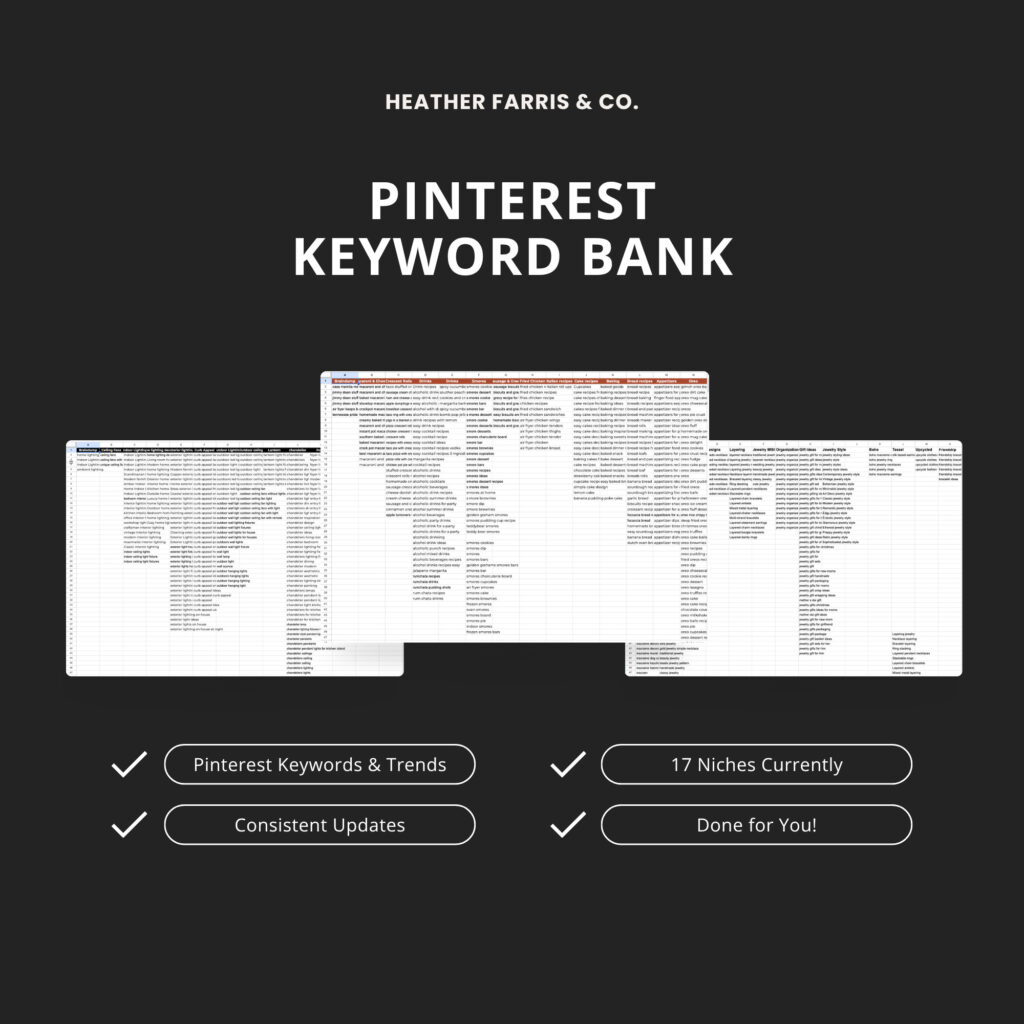
Fueled by 8 years of experience, and a track record of aiding over 780 students and numerous clients to reach their marketing goals, the Keyword Bank is expansive and dynamic, covering a plethora of niches
This Keyword Bank is up-to-date with the latest trends, ensuring that your pins stay relevant and continue to draw attention.
Creating Pinterest keywords for pins
Now, pins target specific searches that pinners on Pinterest are searching for. Let’s say that a tea creator writes a blog post titled ‘Five Health Benefits of Drinking Green Tea’. The creator then chooses a list of keywords to include in the pin description, long-tail options that all fit.
- Green tea benefits
- Benefits of drinking green tea
- Green tea for weight loss
- Green tea for metabolism
- Green tea health benefits
Those are five different ways that someone is searching for this particular topic on Pinterest. You’re then going to write sentences around those, placing them in the pin description. You can even choose one of those as your main text overlay, keyword on actual pin text.
But those aren’t the only pins that can go on that board. These pins can also go on other boards, it’s not set in stone, but they need to certainly compliment each other.
RELATED: How to Write Your Pinterest Descriptions to Get More Clicks & Rank Higher
How boards and pins can work together
Here is an example of how some pins for tea topics work together on different boards, and vice versa. Although we have three pins with different topics, they can variably go on either on of these boards, based on the content of those blog posts, or how the pin descriptions support the board topics.
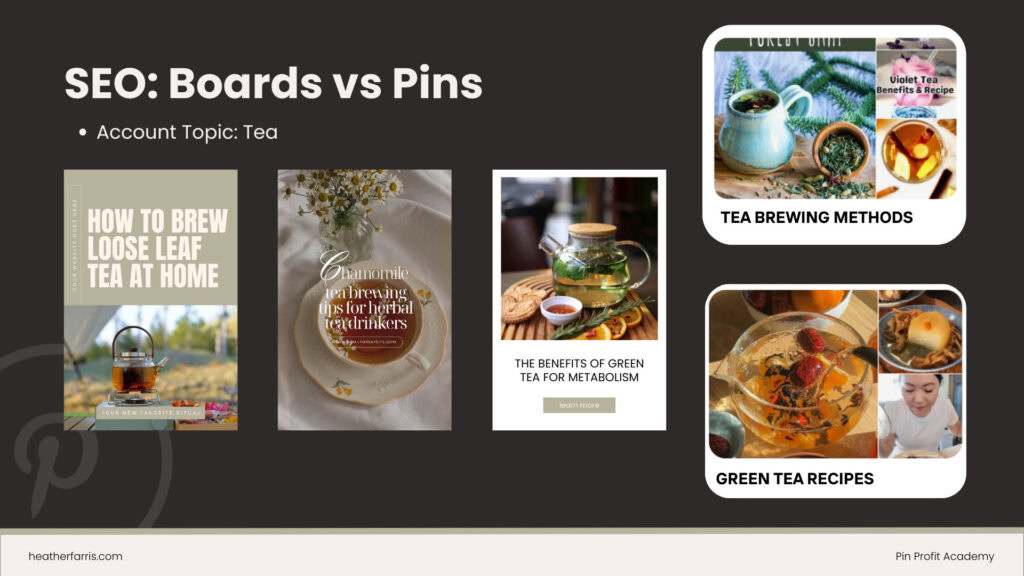
Easily, the first two pins can go on the ‘Tea Brewing Methods’ board, and the third pin would clearly go on the ‘Green Tea Recipes’ board. However, inside of the first brewing pin, it could include a recipe, so it could go on the recipes board. Same with the green tea pin, it may have a section inside that talks about how to best brew the green tea in order to get all the benefits. Hence, it can also fit on the methods board.
Again, the board tells Pinterest the topic. Pins dive deeper into the specific Pinterest keywords and what the final content is about.
RELATED: Use Tailwind Ghostwriter to Write Your Pin Descriptions For You
Common Pinterest SEO Mistakes
We’ve gotta talk about mistakes across your boards and pins with your Pinterest keywords because all of these things will make a big difference in your marketing strategy.
- Board is too broad
- Board is too specific
- Overused single keywords
Pinterest Board optimization is too broad
Mistake number one is your board is way too broad. If your board names are just one word (recipes, tea, sneakers, etc.) Pinterest is going to have a very difficult time finding you the right audience, to actually serve up your content to them. They’re going to know the board is about tea, but the biggest issue here is most people don’t have a board description where the Pinterest keywords matter even more.
I was just doing an audit with someone last night and they didn’t have board descriptions at all. They just had their board titles, and still relevant pins on those boards. But their pins weren’t getting any outbound clicks or even saves. So no real engagement, likely because of the board not being optimized well enough.
RELATED: How to Increase Pinterest Engagement With This Single Tactic
Your boards are far too specific
Mistake number two is that your board is way too specific. This is okay in some instances if you want to have a very hyper-specific board because you create a lot of content in that area. But you don’t want to do that every single time.
If you make any edits to the title of a board because it’s too specific, Pinterest has to re-index it. Then all of the reach and everything on those pins is going to be interrupted to start over. You don’t really want that to happen. Your keyword targeting for those specific keywords, really should live at the pin level, not the board level.
RELATED: How Pinners Discover New Content on Pinterest
Using the same Pinterest keywords constantly
Mistake number three doesn’t apply much for established creators with consistent growth on Pinterest. It is for beginner creators when they’re starting a Pinterest marketing journey. This mistake is using the same keyword on every single Pinterest pin.
Diversity is important. Even if you have a very tight niche audience because you only do one thing, there are still many different ways people are searching for your topic. Not everyone searches the exact same keywords every single time every day.
RELATED: 7 Things Missing in Your Pinterest Content Strategy
Final thoughts on Pinterest keywords for pins and boards
Without Pinterest keywords for pins and boards in your marketing strategy, you won’t have success on the platform. Throwing metaphorical spaghetti at the wall and hoping random pins stick does not lead to success with Pinterest.
Your brand is the trunk of a tree, the pillar topics are the major branches, the board sub-topics are the minor branches, and the pins are the leaves and flowers coming off the branches. Things have to “branch-off” the correct way in order to grow.
If you want more help fine tuning your Pinterest marketing strategy, join us in Pin Profit Academy. There is so much more to the systems and processes for a successful presence on Pinterest than just keywords. But you’re in the right place to start! So take the next step and join us inside.
Pin Profit Academy
Marketing can be difficult and trying to figure it out on your own, especially with Pinterest, can be overwhelming.
I will show you how to double your traffic and sales without spending another minute on social media!
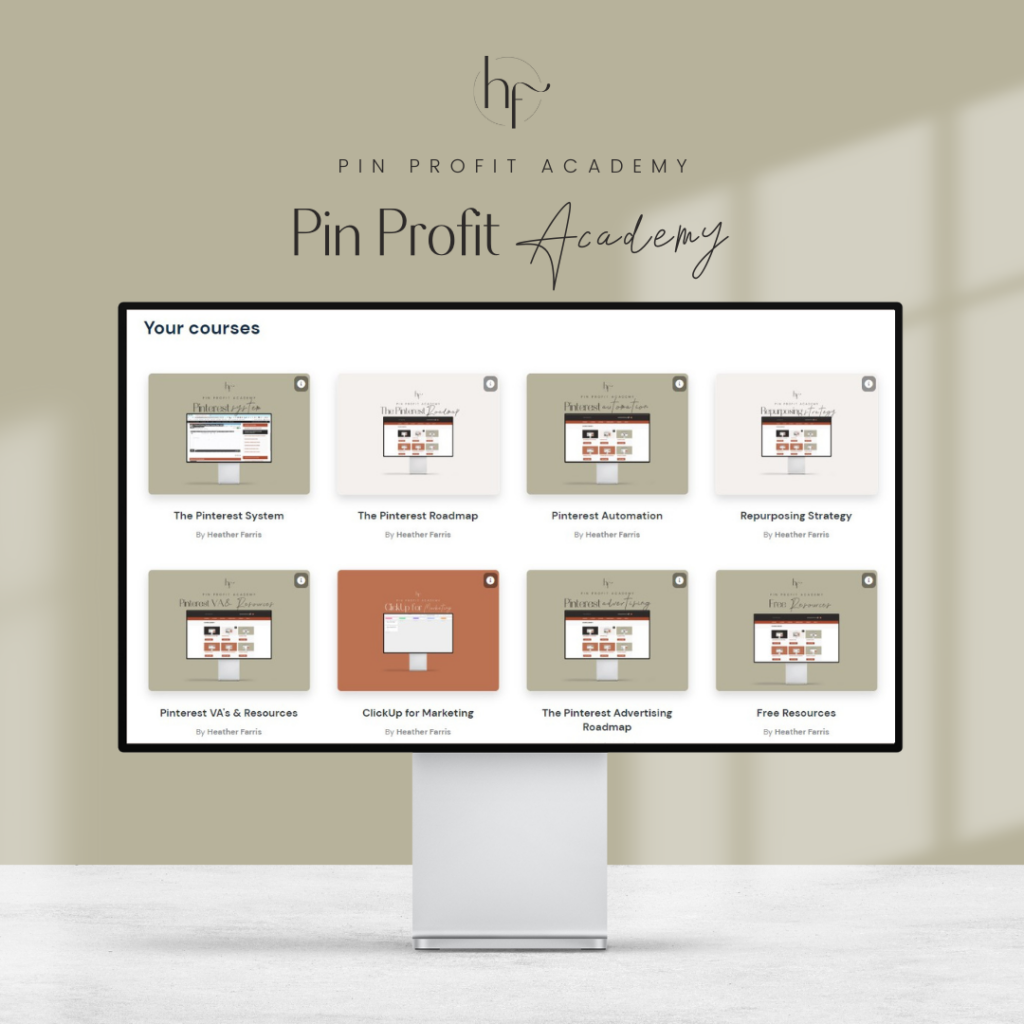
PPA is the only comprehensive membership program & community for creating, marketing & selling your products & services using Pinterest.
Pin it for later

Heather Farris went to school for accounting and worked for years in banking and finance. After finding all of that entirely too boring she started her first blog in her basement in August of 2016. She has started 3 blogs in the marketing, motherhood and travel niches and used Pinterest to grow them all. She quickly became the go-to Pinterest strategist in her peer circles and has been implementing strategies, driving traffic and sales through organic and paid tactics for her clients. On this blog and her YouTube channel, as a renowned Pinterest marketing expert, she educates the public about clear and transparent marketing strategies to help them to grow on Pinterest and in other places online. She created Pin Profit Academy and helps small business owners just like you to master their Pinterest marketing strategy. Heather is now a Pinterest Educator, one of the very few sponsored by Pinterest.