

How to Make Pinterest Pins for Affiliate Products
There is a right way and a wrong way to make Pinterest pins for affiliate products. I’m not sure about you, but I’m really sick of being sold to. I used to like to go on Pinterest and browse and dream and pin things to my Pinterest boards.
Now it just seems like a big slop fest full of spammy affiliate products. If it’s going to become a product marketplace, which is seemingly where we’re headed, I want to at least train a few people on how to make better affiliate marketing pins.
We’re going to talk about the kind of strategy behind making affiliate pins. And the types of Pinterest pins that you should be making for your Pinterest strategy. We’re really honing in on one specific thing in this video, and that is making Pinterest pins for affiliate products that look better and that help you actually do the job.
Why affiliate pins often fail
We are constantly being sold to everywhere you look, especially as Americans, I can speak to that. It’s exhausting.
- Billboards
- Social media ads every other post
- T-shirts
- Receipts
- Car wraps and window stickers
- Junk mail
- Toilet stall doors
A lot of creators are treating their affiliate pins as advertisements, they might take a white background photo and slap it on a Pinterest pin and put the name of the product on there. I’ve seen some pretty bad ones.
If your affiliate pins feel like ads, that could be why they’re not converting. Let’s talk about the problem and then dive into how to fix it.
RELATED: How to Make Pinterest Product Pins that Convert
Pinterest pins for affiliate products that work
If we’re being honest with ourselves, that’s not really why people are on platforms like Pinterest. They’re there to be inspired. They’re there to find content and things that are going to help them be who they want to be, and better versions of who they already are.
Pinterest users are looking for something that is generally going to improve their lives. For example, let’s take a creator that works from home, or a small business owner doing digital products and services. They’re on Pinterest for:
- a better desk setup
- a thing that’s going to fit into their preferred aesthetic desk layout
- a better mouse that isn’t that ugly flat Apple mouse, but actually comfortable
- a better tripod that is more multi-functional
- or a better lighting setup for photo shoots that travels easily
But they are there generally because they are the people who want things to look nice, feel right, but also be very practical.
RELATED: 7 Things Missing in Your Pinterest Content Strategy
The three jobs of a good affiliate product pin
There are really three main jobs that I see affiliate pins needing to do, and even product pins for that matter. If you’re a product seller as well, these also fit into your everyday workflow as far as Pinterest strategy, too.
- The Pinterest pin should really connect to a real use case.
- Match what Pinterest is really good at: connecting people to a vibe, an aesthetic (the planning, the dreaming, the desire, etc.).
- Should help the product to become a bigger outcome for the person on the other side of the screen.
I’m going to show you some examples, and I created pins around photography products to illustrate this. You’re probably going to have to do a little bit of that legwork before you’re ready to actually make the pins too.
Weak pins versus strong pins
Let’s talk about what makes a weak affiliate pin before I show you the pins that I’ve designed for you. A weak affiliate pin is like a product on a white background, or maybe a product on a desk, but it’s really only focused on the product itself. It looks like the final pics in a shop listing right before you buy. Here’s what I mean…
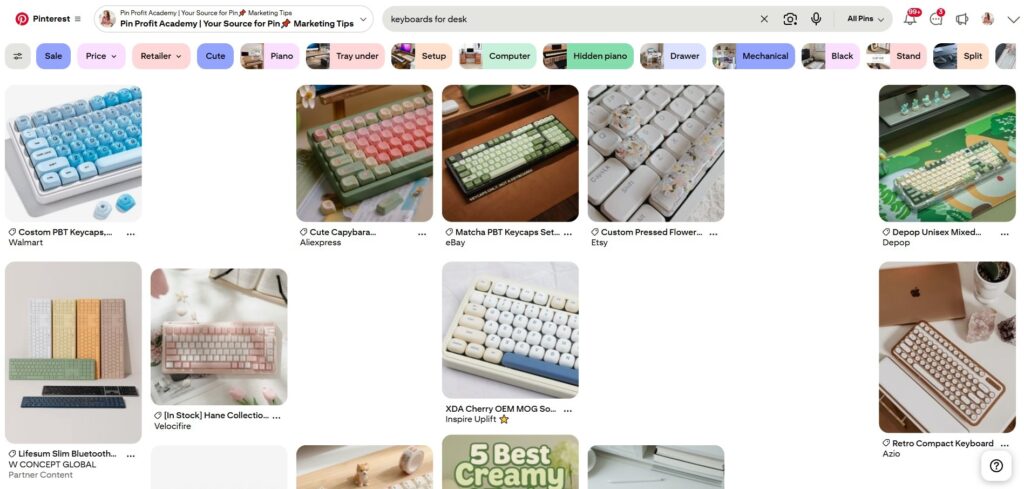
Oftentimes, these pins are getting clicks, but the amount of traffic that you need to these kinds of pins, is going to need to be pretty great. That’s where I come in with teaching you how to make more outcome-driven pins, we’re showing the desired outcome for the viewer.
That way people can actually connect to the product, and they don’t just feel like it’s an ad and they’re being sold to. This would be a much better type of affiliate pin below…
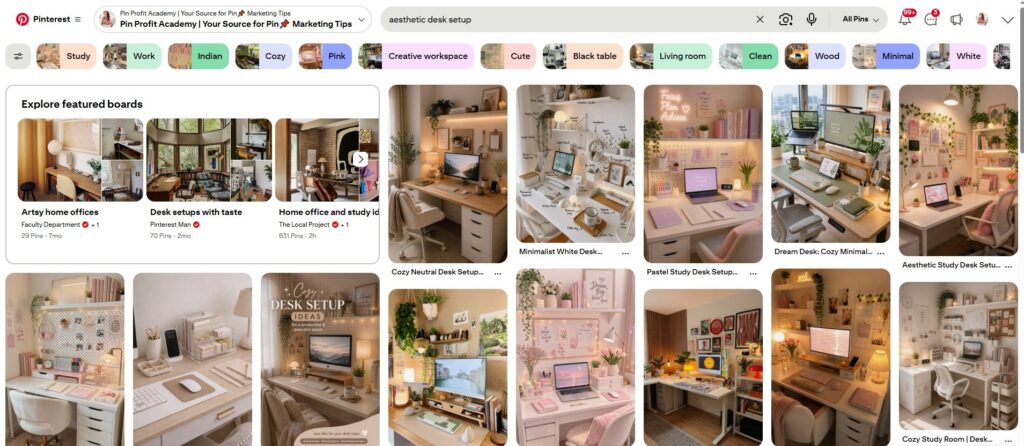
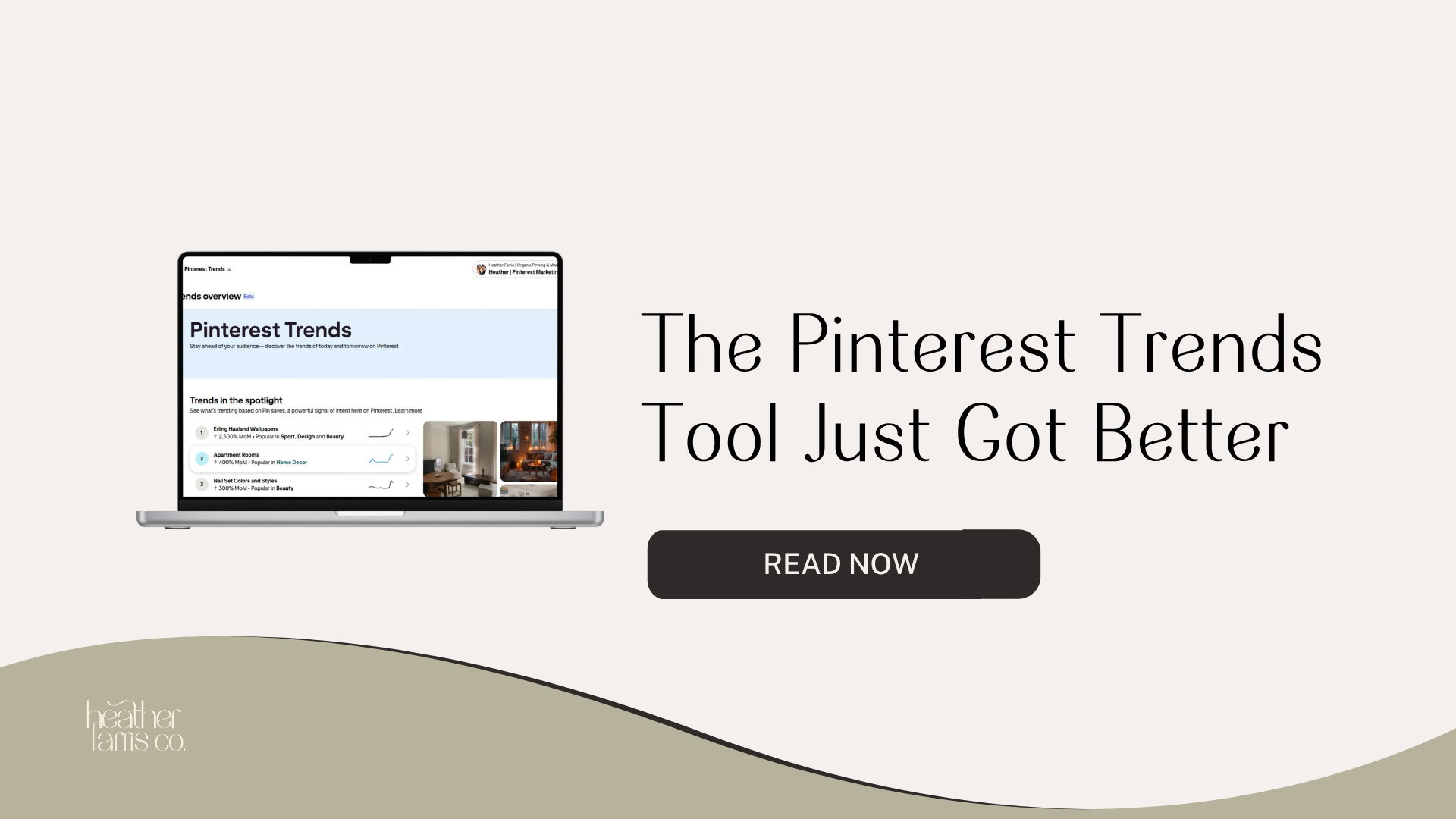
In this example, it’s an aesthetic desk setup. This is an actual Pinterest keyword in the trends tool that people are searching for right now. It’s a pretty popular topic.
RELATED: How to use Pinterest Trends with the New Updates
Keywords for strong Pinterest pins for affiliate products
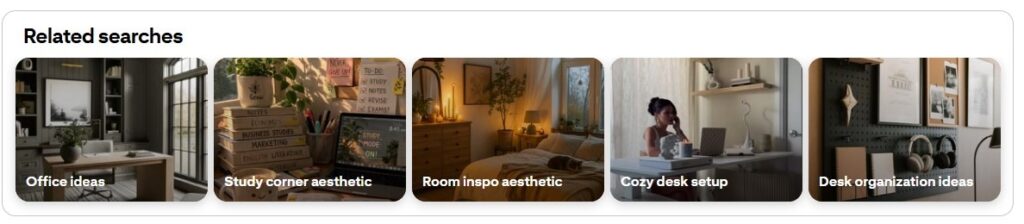
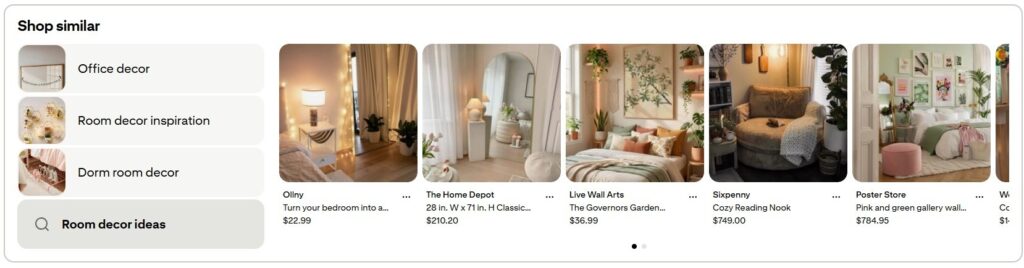
So when you find your affiliate product’s ‘aesthetic’ that fits the 3 jobs your pins need to be doing, right in the search results you’ll see all the recommended keywords and topics you can apply to your affiliate pins. Just scroll down and you’ll see sections with:
- Related searches
- Shop similar
- More to explore
And all of those sections have keywords right in the lists and images that you can add to your Pinterest pins for affiliate products, if they’re the niche or topic and fit well.

RELATED: How Pinners Discover New Content on Pinterest
Making strong Pinterest pins for affiliate products
So now, what I want you to do is go ahead and work on your skill of connecting products to a use case, a feeling, a result someone actually wants, through the aesthetic you create with your affiliate product pins.
I’m going to walk you through a different set of different examples that I created, meeting our criteria we want. And I’ve labeled them as such for easier reference.
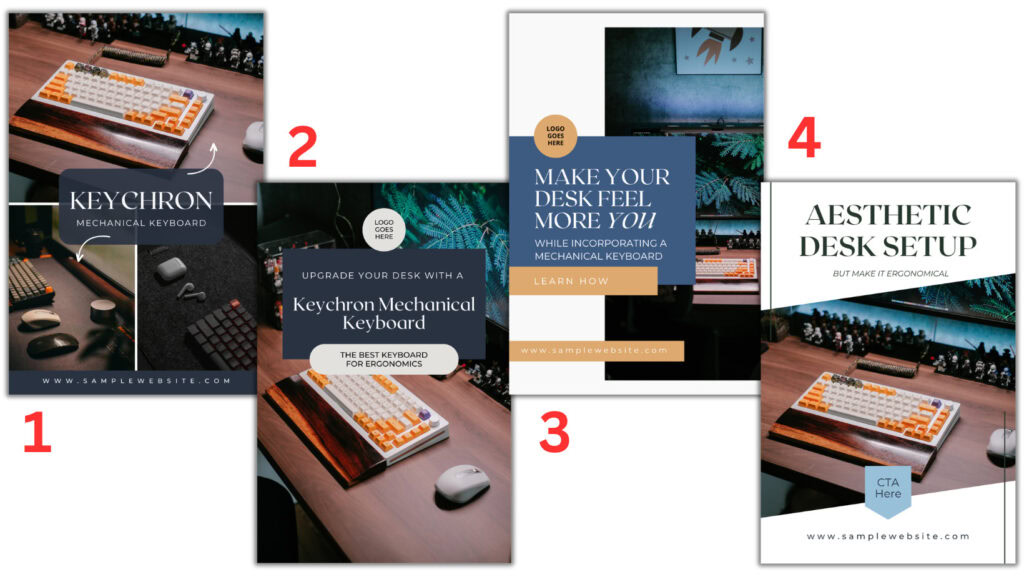
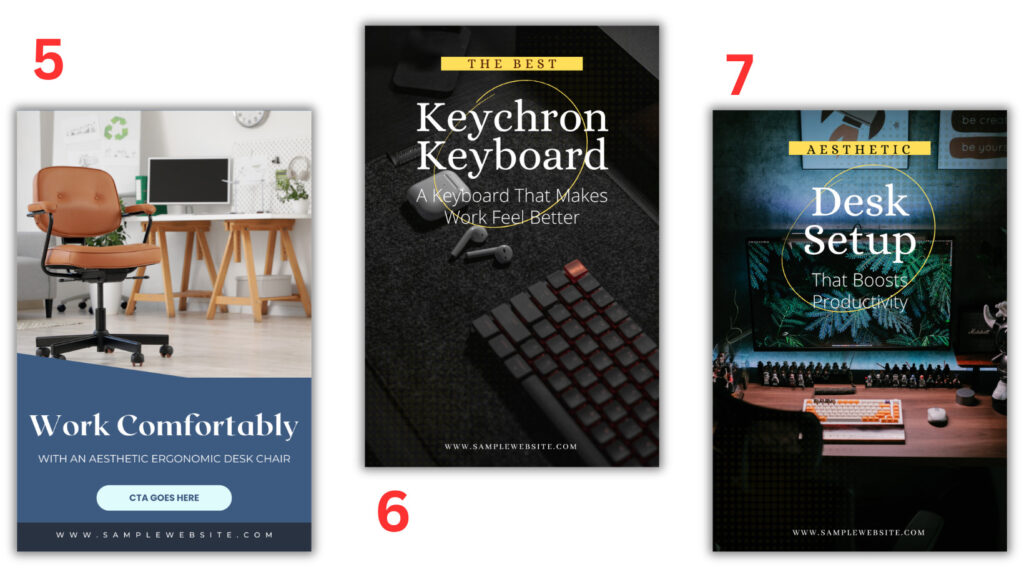
All of these images are from Canva’s photo library. Sometimes there are photos for affiliate products that you can definitely find in stock photography. If the company you’re an affiliate for is half decent with their affiliate program, they may provide the imagery that’s approved or that you can use without dealing with copyright issues.
Pin #1 – This is a product-only example. Based on the journey your customer goes through, this is more of a final pin when they know exactly what they want and are ready to buy. But it does still contain the final aesthetic on the desk, feeling more personal.
Pin #2 – This pin is very outcome based because it’s speaking to the health of the customer, looking for an ergonomic keyboard. So I included that in the text overlay. I personally have one of these keyboards and have used it for 6 years because of the great ergonomics it has.
Pin #3 – An emotional appeal is the next example. With the heading “Make your desk feel more like YOU”, and then the subheading text is whatever keywords you want to target that further support emotionally.
- While having a mechanical keyboard
- While incorporating an ergonomic design
- While keeping your health in the forefront
Pin #4 – This one is more aspirational and desire driven. Someone wants an aesthetic desk setup, but makes it ergonomical. Right? We do a closer shot showing a wrist rest, and we have a keyboard that is angled up and is not flat.
Pin #5 – This one focuses on working comfortably with the right chair, and we can see the whole thing while still feeling the aesthetic of the whole image.
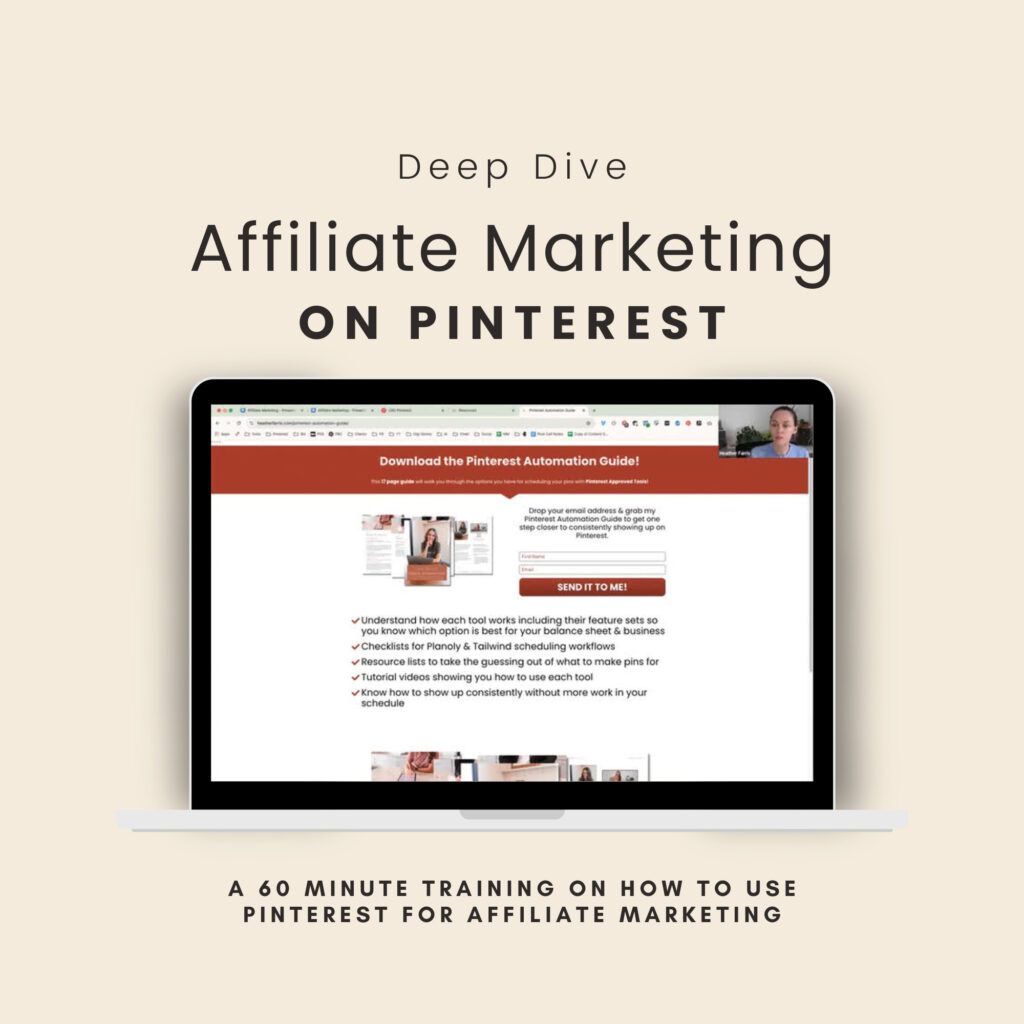
How to Use Affiliate Marketing in Your Pinterest Strategy
Learn how to drive affiliate sales, get more traffic for free, and promote affiliate products effectively on Pinterest, and witness a transformative change in your business.
Presented by an expert in Pinterest marketing, this deep dive training provides in-depth insights that have been meticulously compiled from years of proven success with a diverse range of clients and businesses.
Pin #6 – Okay, this pin speaks to desire, a keyboard that makes work feel better. The desire comes in with the subheading and the intimate product shot.
Pin #7 – The last one is aspirational and outcome driven. It’s the aesthetic desk setup, but it is also talking about boosting productivity.
The different ways that you can approach this really does vary. You can definitely structure these pins with the searchable text overlay and title and an image that really speaks to what you’re trying to sell.
RELATED: How To Make Pinterest Pins For Physical Products
Optimizing your affiliate pins
The image itself should support the promise that you’re making, and the pin is going to ultimately speak to what that promise is. That’s it. That is how I like to talk about, look at, plan, and strategize pins for affiliate products. Now, a couple of things to remember as you build out these affiliate product pins.
- Use a main keyword in your text overlay and your pin title
- Use a variety of different keywords in the pin description itself
- Pins should link to varied content that are all affiliate in nature: blog posts, videos, podcasts, directly to the affiliate link.
If you’re doing this well, you’re more often linking to a piece of content where you discuss the product and then you link to it in that blog. Just make sure that the blog itself (or the YouTube video, podcast episode, etc.) is actually created for that conversion.
RELATED: How to Optimize Your Blog Content for Pinterest Users
How to be tagging your affiliate product pins
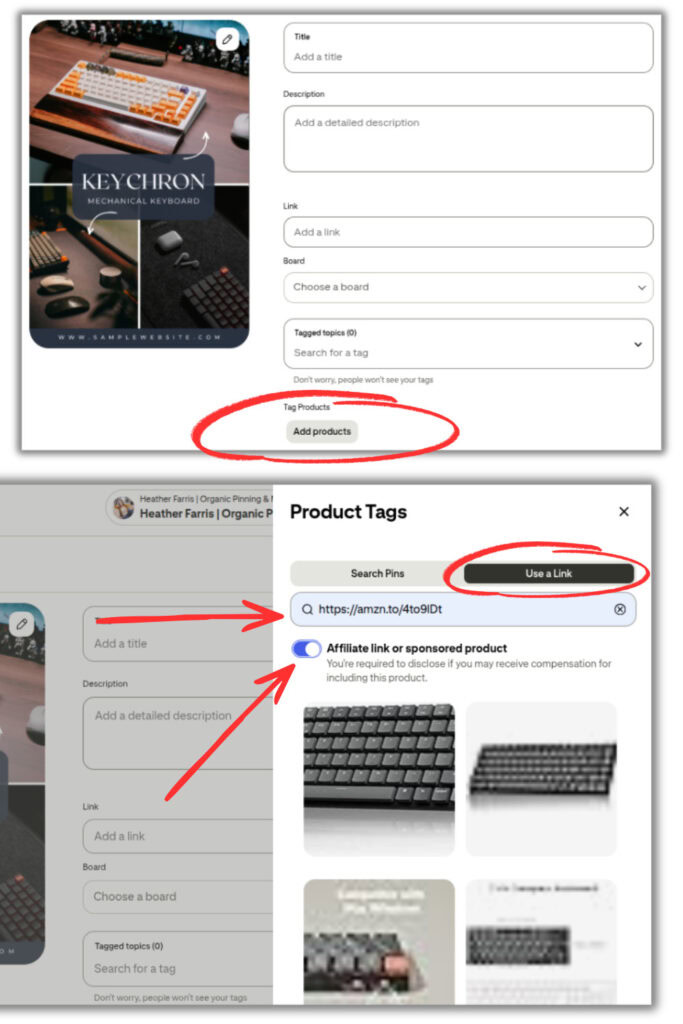
Now, if you are creating Pinterest pins like these where it’s clearly displaying products only, you can definitely link directly to the affiliate link. Just make sure you turn on the affiliate link toggle when you create your pin. This is how you do that:
- Go to the Pinterest native pin builder to create a new pin.
- Upload the pin image you’ve created.
- At the bottom of the window, click ‘Add products’.
- Select ‘Use a link’ in the new window that pops up.
- Paste in your affiliate link for the product.
- Toggle the ‘Affiliate link’ option to ON.
- Click any product image that pops up to tag with your pin.
Then finish optimizing your pin with all the title, descriptions, board, etc. so it’s complete. Then publish or schedule your pin. If you don’t have a disclaimer on your pin description, you have to have this affiliate toggle turned on so that it’s properly disclosed.
RELATED: How to Write Your Pinterest Descriptions to Get More Clicks & Rank Higher
RELATED: How to Tag Products on Pinterest and Make Money With Your Pins
Final thoughts on how to make Pinterest pins for affiliate products
Pinterest has become oversaturated with pins that look like ads, and that’s probably why your affiliate pins aren’t converting the way you want them to. When you shift your strategy to connecting products with real use cases, emotions, and aspirational outcomes, everything changes. This leads to higher conversion rates and a better income from your affiliate efforts.
If you’re ready to take your Pinterest strategy to the next level and learn how to build a profitable pin system from the ground up, I’d love to have you join me in Pin Profit Academy. We dive deeper into strategy, scaling, and everything it takes to turn Pinterest into a real income stream.
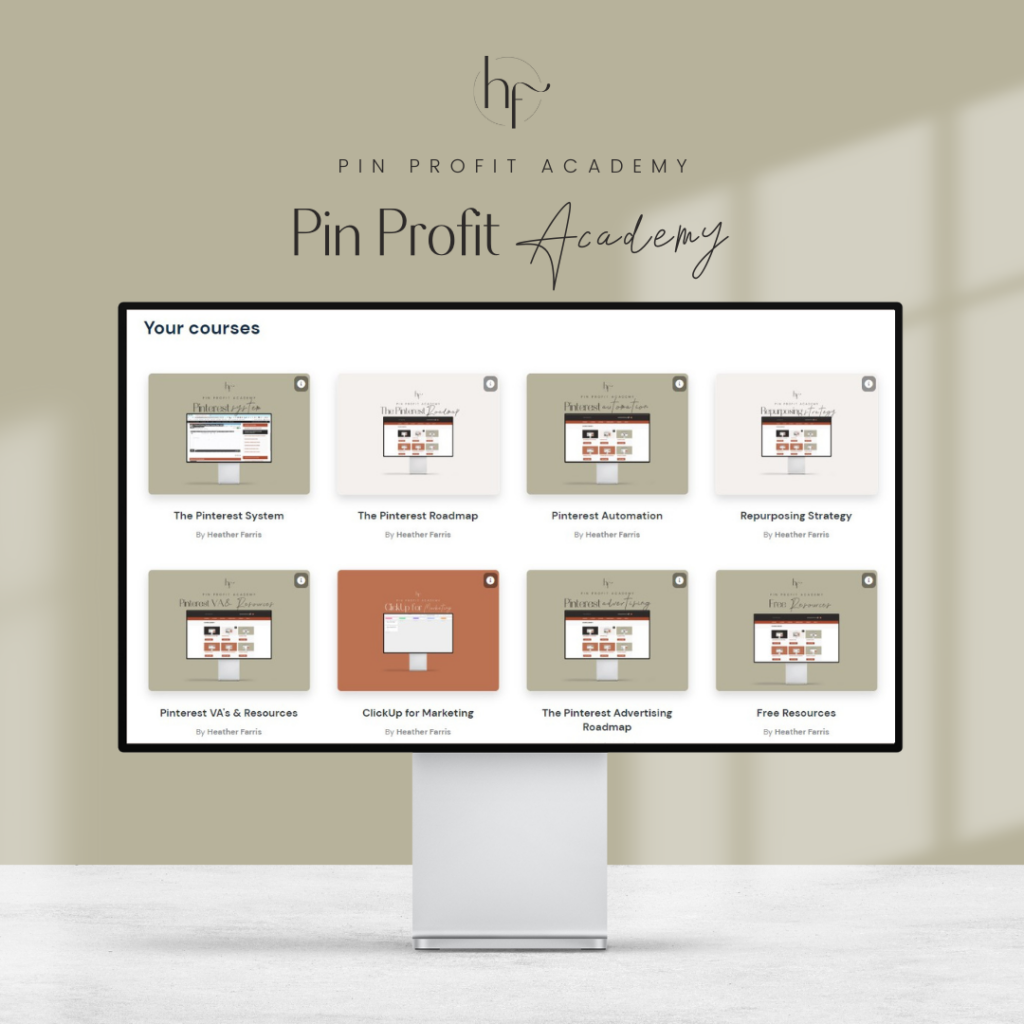
Pin Profit Academy
Marketing can be difficult and trying to figure it out on your own, especially with Pinterest, can be overwhelming.
I will show you how to double your traffic and sales without spending another minute on social media!
PPA is the only comprehensive membership program & community for creating, marketing & selling your products & services using Pinterest.
Pin it for later

Heather Farris went to school for accounting and worked for years in banking and finance. After finding all of that entirely too boring she started her first blog in her basement in August of 2016. She has started 3 blogs in the marketing, motherhood and travel niches and used Pinterest to grow them all. She quickly became the go-to Pinterest strategist in her peer circles and has been implementing strategies, driving traffic and sales through organic and paid tactics for her clients. On this blog and her YouTube channel, as a renowned Pinterest marketing expert, she educates the public about clear and transparent marketing strategies to help them to grow on Pinterest and in other places online. She created Pin Profit Academy and helps small business owners just like you to master their Pinterest marketing strategy. Heather is now a Pinterest Educator, one of the very few sponsored by Pinterest.