

Pinterest Tools and Resources I Recommend for Marketing
Most of the time when I get asked about Pinterest tools from small business owners, I say I don’t recommend the one they’re considering. But after doing this for almost a decade, here are all of the Pinterest tools and resources that I DO use myself and recommend on the regular.
I’ll walk you through and chat about these tools I use for:
- Marketing systems
- Graphic design
- Scheduling content
- Business analytics
- Websites and blogs
Pinterest tools and value considerations
I think really good marketers often feel FOMO. There are so many tools, new ones popping up everyday, that we want the most effective use of our time and for our business. Worrying that a different tool does better isn’t ever helpful. So hopefully these will help you decide or get you at least one option that works great for you, by hearing from someone else.
The Pinterest tools that I use are either free or very, very affordable. That is actually a good thing for most beginner to intermediate Pinterest marketers, because you’re not wanting to spend hundreds of dollars a month, or even yearly, on things just to help your business run. So let’s cover these.
RELATED: The Complete Pinterest Marketing Strategy I Tell My Friends
Pinterest pin scheduling tools
I use two main schedulers, not only in my business but for my clients’ businesses too. We trust these tools and have seen the results we get when we use them. They are:
- Pinterest pin builder
- Tailwind
The native scheduler right on Pinterest is completely free. It also has full functionality of options with Pinterest you cannot find elsewhere, like tagging products you’re pinning. The other one that I use and often go back to is Tailwind. Tailwind has multiple ways it can present your data and organize your content that other tools really don’t have.
In general, I prefer my tools to do either one thing really, really well, or a handful of things really well. I don’t want an all-in-one and the kitchen sink kind of tool. Because usually they’re just asking for a higher price for lower quality additions all throughout. I try to avoid that.
However, Tailwind is not one of those. They have been around the block for a long time and they do Pinterest scheduling really well. They do AI copy, connections between blogs and shops really well now too. Tailwind is really robust and you get a lot of bang for your buck.
RELATED: Tailwind Updates For Pinterest Marketing Automation
Graphic design tools
Let’s talk graphic design now, because your Pinterest marketing strategy must include amazing visuals for your pins. I have one tool and one tool only for this, and it’s Canva. I honestly don’t know what I will do if Canva ever goes away or becomes outrageously expensive.
Canva gets used for everything: for clients, my students, even to teach with. The reason why I like to use this particular graphic design tool is because it makes it easy for communication in all ways. People can plug in and learn how to design easily. It’s easy for me to show you how to do something, and you actually understand how to use it. It’s easy to connect it with other tools.a
I do not care to use Photoshop, Figma, or Adobe Express or any other tools. I only use Canva. You can even go as far as using Canva for your Pinterest scheduling if you don’t want to have to pay for another tool, which is a perk.
RELATED: How to Create Pins for Pinterest in Canva: An Image Workflow to Save Time
Keyword research and Pinterest SEO
Research is probably the most commonly asked question as of late. People ask if I use specific keyword tools. There are many complex options, and most you have to pay for. Most don’t specialize in Pinterest SEO anyway, but focused on Google.
So I do not care to use third-party tools when they’re going to give me the data and information I need. I use Pinterest and Pinterest alone for my keyword research. They provide many free options that I’ve discussed in length: the search bar, trends and yearly predicts data, and inside of the ads manager.
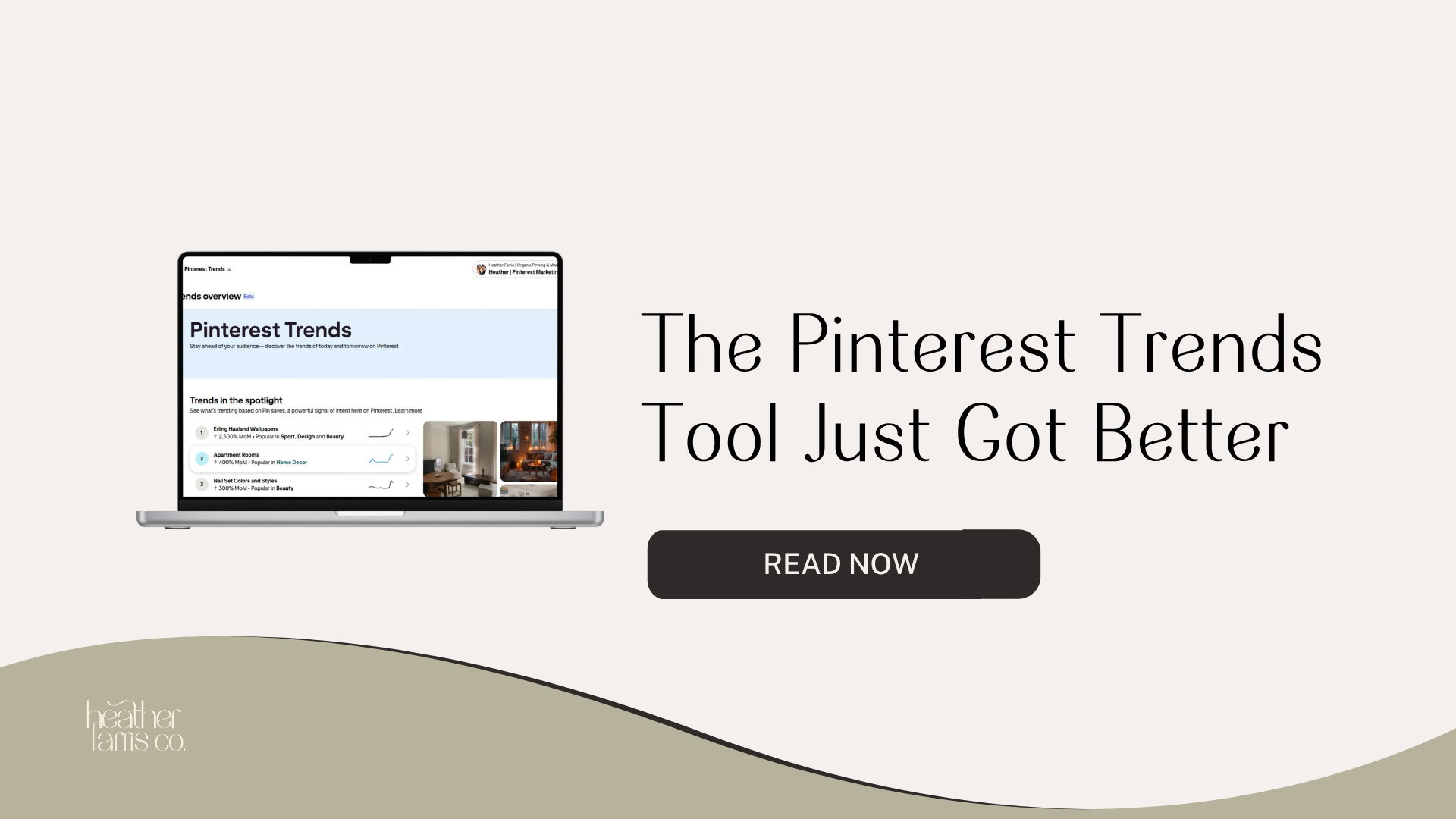
RELATED: Pinterest Trends: How to Use This Keyword Tool for Content Planning
Website and blog platforms
Website platforms actually matter in the way that they connect to Pinterest, and how you share content to Pinterest. Not every website or blog platform is ideal, or even works well with Pinterest. It matters how you can go about claiming your site, installing your Pinterest tag on them, and how the information flows between both.
There are some new kids on the block when it comes to website platforms, and they’re probably cropping up every single day almost like a bad disease. The ones that I use regularly and recommend are:
- WordPress
- Squarespace
- Shopify
My sites aren’t on Squarespace, but I have a lot of clients that use Squarespace. One of my very favorite Pinterest managers builds websites on Squarespace and I think it’s a really solid website platform.
Shopify is also a very viable option for e-commerce. I use it for my own business and am looking to use it even more. I recommend it to other people that are looking to get started with e-commerce but don’t want to go to Etsy. It’s a really solid platform and has been around for a really long time.
RELATED: Why You Need to Optimize Your Website for Pinterest
Shopping cart software
Let’s talk shopping cart software because we are all in the business of selling things, whether you are creating digital products, selling physical products or services, or whatever. Even if you’re not particularly in the e-commerce space with a whole storefront, you’re often needing to take payments for items you’re selling, even just one-off products somtimes.
Popular cart software like ThriveCart, SamCart, SendOwl, and Shopify, just to name a few, are all very worthwhile tools that you can use.
I personally have been using ThriveCart since I started my membership. I also use Shopify for all my product listings. Also, sometimes I do just go straight to Stripe and create invoices and products, and straight to PayPal to use for the same thing depending on the situation.
When it comes to cart software, just find one you like, because they’re easy to back out of and set up with a new one at any time. They do all have different rates and integration options that just take a little research and experimentation, but they all work with most platforms.
RELATED: ThriveCart Review: Sell Digital Products Like a Pro
Pinterest tools for getting analytics
There are two analytics tools I use, and they’re both free: Pinterest Analytics and Google Analytics. I use Pinterest Analytics for the majority of my Pinterest data, and I use Google Analytics to verify website traffic and users, basically.
I have always used those two tools together to really cross-reference because they’re two very different angles of data. You should be just as familiar with your analytics areas as your content creation and scheduling areas. They’re vital to use together.
Outside of those things, I use my cart software to analyze metrics for revenue. Whatever payment tools you’re using will have their own set of internal metrics and data for review too.
RELATED: Pinterest Analytics 2025: What to Do With Your Pinterest Data
Pinterest tools worth of honorable mentions
A couple more worthy of consideration for your list of Pinterest tools are also things I use periodically, am okay with, or have liked in the past.
- Riverside
- ChatGPT
- Pinterest System
- Convertkit (now Kit)
Some of these have pros and cons, or have ebbed and flowed with use over time, but I still think they’re good to mention. Because my best or current setup won’t fit yours exactly.
Riverside for editing
I am no longer using Riverside because I don’t use it enough at the moment to justify the cost. But when I did, it was fantastic at cutting up my content for repurposing, and pulling transcripts for all my videos.
I will eventually come back to Riverside when I have more time in my business for content. I want to plug in my full-length YouTube videos, grab a transcript, grab the magic clips that it makes, and use them everywhere.
RELATED: Riverside.FM Review: Creating for YouTube to Social Media & Beyond
ChatGPT for my PinBot
I personally pay for ChatGPT, not only for myself but for my team. I teach out of ChatGPT a lot because I created the PinBot inside to help you with your research and content writing. Paying for ChatGPT, I think it is a worthy contribution to my business, and I just adore it, honestly.
I use it to create pin copy, ideate, and to generate content starts around Pinterest strategy. I actually customized and trained the bot specifically on Pinterest marketing, and I use it a lot, because I feel like it does a really good job.
But, I hate the fact that they’re training on all of our data. I really, really, really hate that. I also really, really hate AI images. However, when it comes to speeding up my workflow and processes, I do like it.

The Pin Bot for ChatGPT — Your Pinterest Marketing Sidekick
Stop spending hours writing pin descriptions, SEO blogs, or brainstorming your Pinterest strategy.
The Pin Bot for ChatGPT is your ready-to-use Pinterest marketing assistant, pre-loaded with proven templates so you can create, plan, and optimize content in minutes.
Pinterest System
A most definitely honorable mention is my Pinterest System. I have found it copied and resold time and time and time again from people that have stolen it, unfortunately. However, it means that it is a product that has been validated in the market successfully.
There have been thousands and thousands of sales on that tool. It is something that I use for workflow and content management for my entire Pinterest marketing strategy. I created it when I started my Pinterest management business to manage clients easier, and it has done such a great job that it is still here all these years later.

The Pinterest System
Speed up your client management processes and personal Pinterest marketing strategy with every content workflow and tracking system you need.
Track and manage your content, links, data analytics, keyword research and more! No more wasted time in your product or service business because you’ll have everything you need.
Convertkit for email marketing
I use ConvertKit (now just Kit) for my email software. I’ve used them since 2016, and I do not see myself going anywhere else for quite a while. You need an email software system that captures your leads when they come from Pinterest, to download your freemiums or even take full orders. This does that for me.
RELATED: How to Use Pinterest to Grow Your Email List (The Ultimate Guide)
ClickUp for task and project management
The last honorable mention is ClickUp. I use ClickUp for my daily task management and project. I use that in conjunction with my Pinterest System, with Canva, with my Pinterest schedulers. It is a way for me and my team to come together and systemetize and track, simultaneously or independently of each other, all of the work that we need to get done.
RELATED: How to Manage Your Pinterest Strategy in ClickUp
Running a Lean Business
There aren’t a lot of fancy tools on this list. A lot of them aren’t even paid tools. I try to find things that work really well for my business, that work really well for my brain, and don’t cost me a fortune.
Previously I was an accountant by trade, so I like to run a really lean ship. If I can do that, I’m going to do that. I’d rather pay myself more money and have more profit and put more money into retirement than give software companies my money, just because they’re “fancier”.
Having the latest and greatest or fanciest tools does not guarantee a better run business that’s successful. Yes, the right tools make a huge difference, and there’s a bit you have to decide that you prefer or works best for you. But I know starting from a place that’s recommended by someone who’s been in the business a long time, that it helps.
Final thoughts on Pinterest tools and resources I recommend
Don’t let FOMO make the decision for you in your business. Don’t sign up for tools and forget about them and just keep paying software companies for years. Use your tools or lose your tools. That’s really what it comes down to. The right Pinterest tools won’t build your business for you, but they will support a smart strategy, simplify your workflow, and help you grow without overspending or overcomplicating things.
If you’re ready to go beyond just choosing Pinterest tools and start building a clear, profitable Pinterest strategy, the next step is inside Pin Profit Academy. Inside you’ll learn how to take full control of your Pinterest marketing and turn it into a sustainable growth channel for your business.
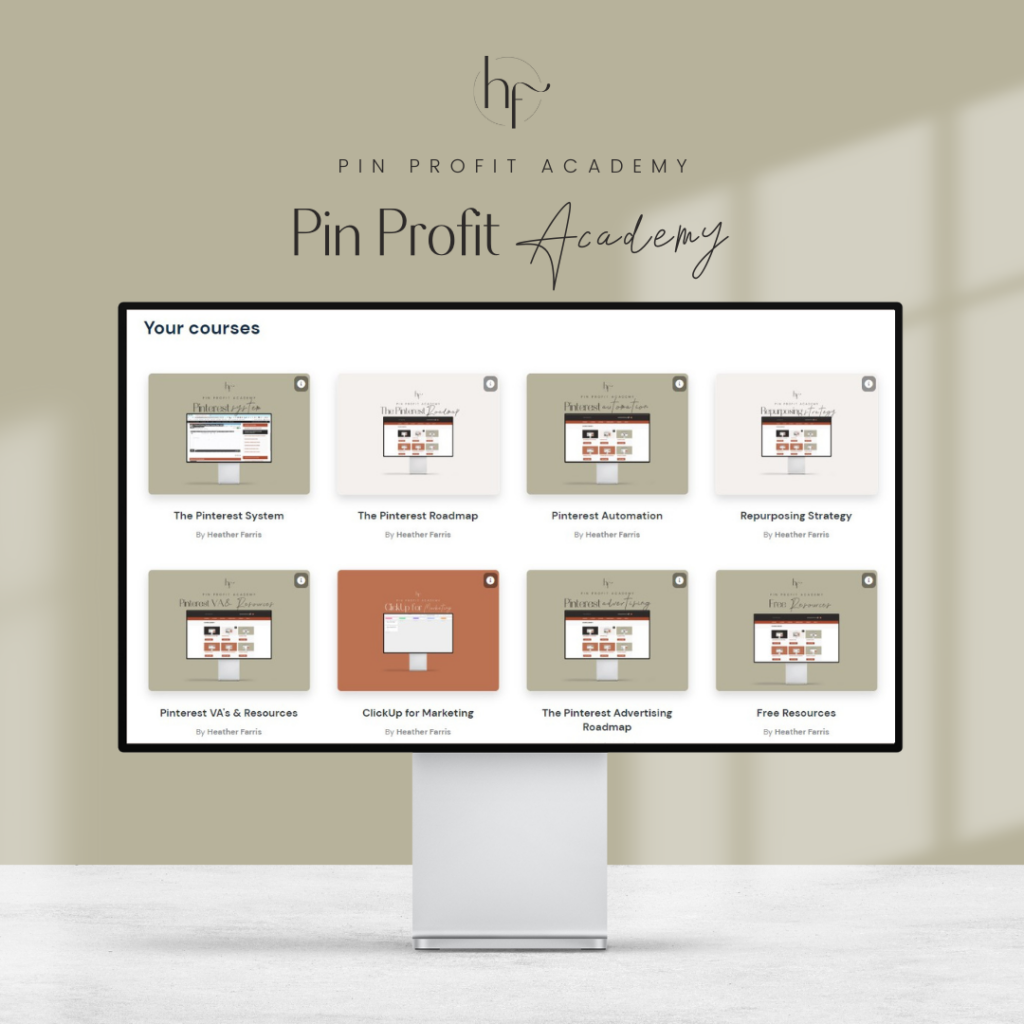
Pin Profit Academy
Marketing can be difficult and trying to figure it out on your own, especially with Pinterest, can be overwhelming.
I will show you how to double your traffic and sales without spending another minute on social media!
PPA is the only comprehensive membership program & community for creating, marketing & selling your products & services using Pinterest.
If you have any more questions about business tools, about marketing tools, about things specifically for Pinterest, please reach out. I’m an open book and I will let you know whether I like them or not. Talk soon!
Pin it for later


Heather Farris went to school for accounting and worked for years in banking and finance. After finding all of that entirely too boring she started her first blog in her basement in August of 2016. She has started 3 blogs in the marketing, motherhood and travel niches and used Pinterest to grow them all. She quickly became the go-to Pinterest strategist in her peer circles and has been implementing strategies, driving traffic and sales through organic and paid tactics for her clients. On this blog and her YouTube channel, as a renowned Pinterest marketing expert, she educates the public about clear and transparent marketing strategies to help them to grow on Pinterest and in other places online. She created Pin Profit Academy and helps small business owners just like you to master their Pinterest marketing strategy. Heather is now a Pinterest Educator, one of the very few sponsored by Pinterest.