

3 Types of Pinterest Content For Your Marketing Strategy
If you have ever looked at your Pinterest analytics and thought, why do I have so many pins with views but no clicks? There is likely an answer and it’s not going to be obvious at first. There are so many reasons why people may not click on a Pinterest pin. In today’s post, I’m going to walk you through the different jobs of Pinterest content and how to employ these into your own Pinterest marketing strategy.
After what you learn today, you’ll hopefully start to gain more reach, engagement, and ultimately more traffic. As a consultant, I do a lot of audits on Pinterest accounts that have a lot of data, and these three types of Pinterest content we’ll discuss today is what I see the most of.
Pinterest content behaves much differently
Now, Pinterest is different. It is not a post and immediate engagement type platform. It’s not social media. People are not going to immediately click on your pins within a short 4 hour window. Even after weeks, some of your pins could sit at zero impressions or impressions and no clicks, no saves. That’s totally normal.
But once you understand the different jobs of Pinterest pins inside of your marketing strategy, you can start to really tailor things more directly towards what you want. I’m going to walk you through the three types of Pinterest content that I most commonly recommend. So you can identify them in your analytics, but also build your Pinterest strategy around them.
RELATED: Pinterest Tasks Not Worth Your Time + What to Do Instead
The real problem most Pinterest marketers face
Let’s first talk about the problem that most people encounter. Most Pinterest marketers choose one metric, and they only care about that one. It could be any of:
- Pin clicks
- Pin saves
- Outbound clicks
- Impressions.
It doesn’t really matter. The faulty philosophy is pick one and stick to that lane. Now, it is totally understandable if you’ve chosen one metric and you panic when your pins don’t perform according to only that metric. Not every pin is meant to drive traffic. Not every pin should be judged based on the same exact metric.
RELATED: Pinterest Analytics: A Simple Guide to Read & Analyze Your Data
The three types of Pinterest content
Okay, so let’s talk about the three types of Pinterest content before we get any further in. We’ve got:
- Discovery content
- Planning content
- Utility content
We’re not talking about pin types (static, carousels, videos, etc.); we’re talking about the substance and objective of the content that your pins are showcasing. Let’s cover each one.
RELATED: How Pinners Discover New Content on Pinterest
1. Discovery Content
The first type of Pinterest content is discovery content. This is the kind of content that is broadly served and usually disseminated widely. It will have high impressions, moderate engagement, and usually lower outbound clicks.
The types of pins more common with discovery Pinterest content are pins that you can’t easily leave the platform on, like video pins and old idea pins. Discovery content is meant to attract attention, but not necessarily meant to drive clicks.
Depending on the season, this content could be specifically seasonal. It can certainly be evergreen as well, but oftentimes we see this happening the most in seasonal content. Also with ‘seasons of life’ type content, like pregnant mothers moving through having a baby.
People browse content on Pinterest as they’re scrolling. They see your pins, it piques their interest, but not enough to click, not enough to save and they move on by. But they start to notice your branding more. This is where not every piece of content should be based on whether or not it did well or not.
RELATED: How to Create Branded Pinterest Designs to Boost Sales
2. Planning Content
The second type of content is planning content. This is the kind of content that people are most often going to save and come back to. Lots of pin saves, especially in the later phase areas of the content. More clicks in the ‘now’ timing content, versus more saves in the ‘later but soon’ timing of content support.
Using that same example of pregnant mothers, they are saving things related to pregnancy and birth and child rearing, parenting, all of that stuff. They’re saving that stuff in phases, like all the pregnancy stuff, saving the birthing and newborn stuff for later, then eventually parenting.
If I was a bride and I was looking to plan a wedding, I am going to be looking at the different phases of my wedding planning, engagement timeline, and all the particulars of my marriage. I’m looking for and saving content in those phases.
RELATED: 7 Things Missing in Your Pinterest Content Strategy
Customer journey with planning
Saves to Pinterest mean “I, as the user, trust this content, and I want to see it again later”. This could be in many forms:
- Recipes that we want to remember for specific occasions.
- “That was a really pretty wedding dress, and I want to take this somewhere and have it made, or shop for it”.
- “Ooh, I really like that lamp and that light fixture. The next time I’m in the furniture store, I’m going to look for this”.
These are the things that people are looking for. They’re thinking it through. This is how they’re living their lives and they’re planning on the platform. Be looking at your content in the same way.

The Ultimate Guide to Profitable Pinterest Content
This comprehensive masterclass dives into Pinterest, for creating and attracting dream companies, with opportunities for brand partnerships and monetization.
Why pin saves are underrated
Saves are not necessarily the end goal, but saves are the most common in turning on the engagement algorithm for you. This is so your audience actually gets served more of your content.
People can have a pin in their feed (impressions) and never actually see it. People can click on your pin, and then be served one or two more of your pins in their feeds. But if they save it, now they’re going to start seeing more of your content on the regular.
Doesn’t matter if your pins are a different keyword optimized pin, if it’s related to the search of someone who’s saved your pin, or in their recommendations, your other pins will also more likely show up for them.
RELATED: How Pinners Discover New Content on Pinterest
3. Utility Content
The third type of content is utility content. It is click-led content. This content pays the bills for a lot of creators that monetize via ads. These are the pins that drive those views and clicks that make that money.
For people who sell products, these are the pins that drive traffic to the website. Whether they’re buying that exact product, or doing something else that then converts to a sale. Whether it’s organizing, food, beauty, fashion, whatever… It’s the pins that are getting the most clicks and are the easiest “yeses”.
They are not the really complicated cookie recipes that are going to take 3 days to set in the refrigerator. No, they are cookies that you can mix up and you can put in the oven right now, fast and easy. Content that is useful right now.
RELATED: How to Increase Pinterest Pin Clicks With a Strong Keyword Strategy
Compounding the content winners
Now you know what the three types of content are, discovery, planning, and utility. Sometimes there are going to be pins that show up across all three areas and those are our winners. Those are where we want to nurture these pins and continue to serve them. And this is actually a really common question I get.
“Heather, I have this pin. It’s doing really well. How do I continue this, or how do I replicate this?” The answer is always, “Let’s compound it.” Okay, this is digital asset gold, this is compounding interest with your content.
Let’s continue to feed the algorithm with what Pinterest seems to love and trust. Now, it’s not a realistic goal to chase pins that are going to be in all three categories, they will be fewer. But obviously we can build a system that helps to produce content in all three categories.
Next we need to talk about how to analyze your content so you can start to notice the patterns that match this desired compounding across the different types of Pinterest content for your marketing strategy.
RELATED: Why You Need a Content Strategy Before You Ever Begin Marketing
How to analyze your Pinterest content
These are the things that I see when I’m analyzing and auditing these Pinterest accounts that we’ll cover.
- Pins with high impressions
- Pins that have high impressions leading to clicks
- Pins with high save counts
- Pin clicks versus saves
- Pin clicks on the platform versus outbound clicks to the URL
All of these variables can be pulled in your Pinterest analytics reports and compared against each other individually. We want to compare all of these reports together to see which pins are feeding all the way through from impressions to outbound clicks. These can start to show you patterns in your topics, designs, keywords, in boards that you maybe need to create more of.
Recognizing Pinterest data patterns
While you’re looking at your reports, I want you to be asking these questions.
- What is Pinterest pushing into the feed? (Impressions)
- What do people trust enough to keep on their boards? (Saves)
- What do people click on to go to my website? (Outbound clicks)
I want you to look at those reports and ask those three questions. You don’t need perfect data. You just need consistency and pattern recognition here on a regular basis.
RELATED: Pinterest Analytics: A Simple Guide to Read & Analyze Your Data
Turning data into Pinterest strategy
Now, we’re going to actually turn this into a Pinterest strategy. Because that’s what we ultimately are here to do. A balanced strategy looks like having:
- Discovery content for visibility
- Planning content for trust
- Utility or click content for traffic and sales
For example, looking at your content that gets clicked the most often in say November, you might actually back up and look at September and see what was getting the most saves then. This is why we want to download this data and we want to look at it month after month.
In general, the content that performs the best this month is generally saved months ago. That way we can keep an eye on what’s performing now and what’s going to bring traffic later.
RELATED: How to use Pinterest Trends with the New Updates
What to do with high-performing pins
Let’s talk about what to do if you find pins that are doing really well in saves and outbound clicks. Number one, if it earns a click, expand it. If it earns a save, expand it. What do I mean by expand? I mean make more of them:
- Pins on the same topic
- Boards on a complimentary group of pins
- Convert the great pin into a template for other pins
- Use the same keywords on other similar pins
For example, you’re a recipe blogger and let’s say you have a pin that’s for a chili recipe. It’s doing really well and you don’t actually have a board that’s directly about chili recipes, so add that board.
That’s expanding it, doubling down on it, getting more reach from something that’s working. Let’s use more keywords. Let’s use more trends. And let’s get more people in front of that great content.
RELATED: How to Use Keywords to Optimize Your Pins on Pinterest
Final thoughts on the types of Pinterest content for your marketing strategy
When you understand that the three different types of Pinterest content play different roles, and how you can analyze what’s happening with them, then you can further optimize your marketing strategy.
It’s not about outdated practices of repinning your best pins to every board, spamming your viral pins everywhere. It’s about having balanced content across all areas of a customer’s journey, and quality application of what’s working well.
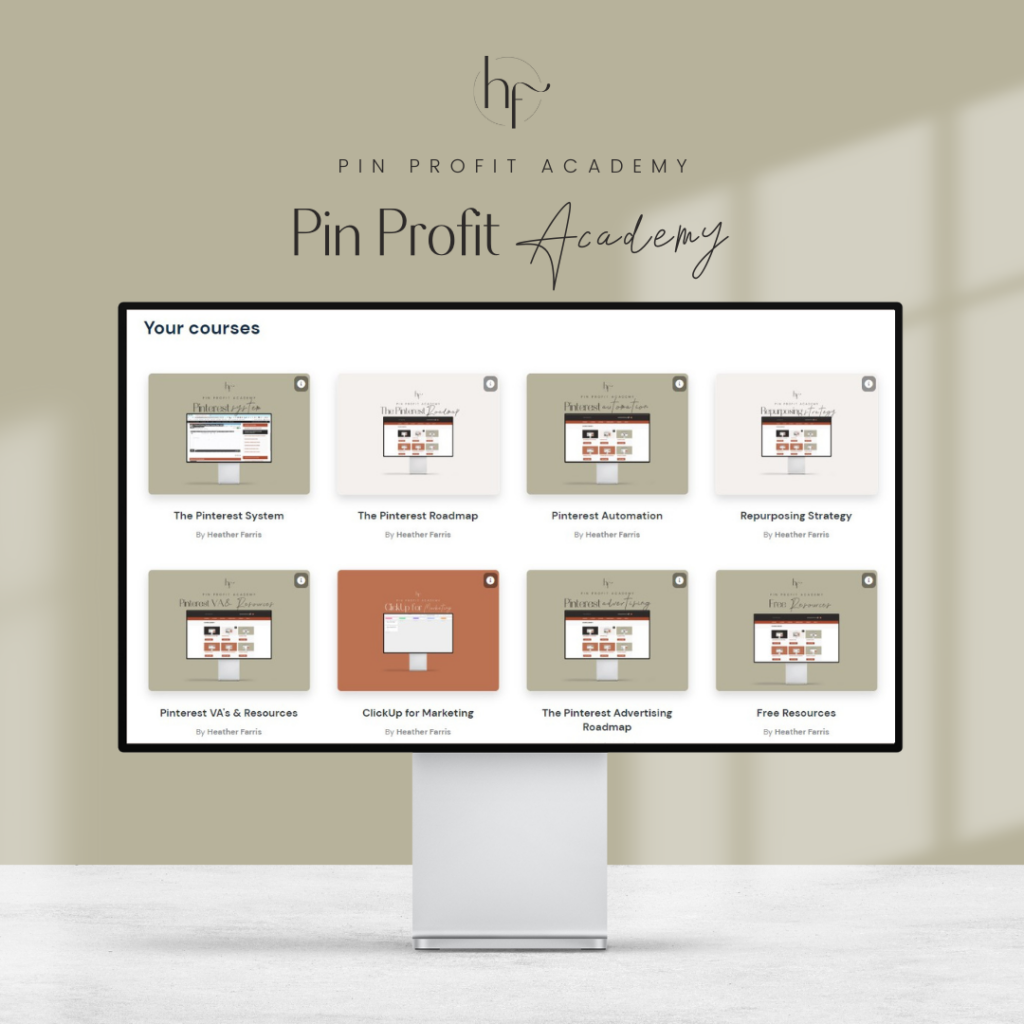
This is probably the most nuanced part of your Pinterest strategy, and having a second set of eyes to assist with this can be really useful. Inside of Pin Profit Academy, you can access private Q&A with me and our whole community to support you and your small business goals with Pinterest. Let’s see you succeed!
Pin Profit Academy
Marketing can be difficult and trying to figure it out on your own, especially with Pinterest, can be overwhelming.
I will show you how to double your traffic and sales without spending another minute on social media!
PPA is the only comprehensive membership program & community for creating, marketing & selling your products & services using Pinterest.
Pin it for later


Heather Farris went to school for accounting and worked for years in banking and finance. After finding all of that entirely too boring she started her first blog in her basement in August of 2016. She has started 3 blogs in the marketing, motherhood and travel niches and used Pinterest to grow them all. She quickly became the go-to Pinterest strategist in her peer circles and has been implementing strategies, driving traffic and sales through organic and paid tactics for her clients. On this blog and her YouTube channel, as a renowned Pinterest marketing expert, she educates the public about clear and transparent marketing strategies to help them to grow on Pinterest and in other places online. She created Pin Profit Academy and helps small business owners just like you to master their Pinterest marketing strategy. Heather is now a Pinterest Educator, one of the very few sponsored by Pinterest.