

How to Use Curated Content on Pinterest
A lot of people get stuck when they are creating their Pinterest strategies because they feel like they need to create everything from scratch. But what if curated content on Pinterest is actually your next growth move?
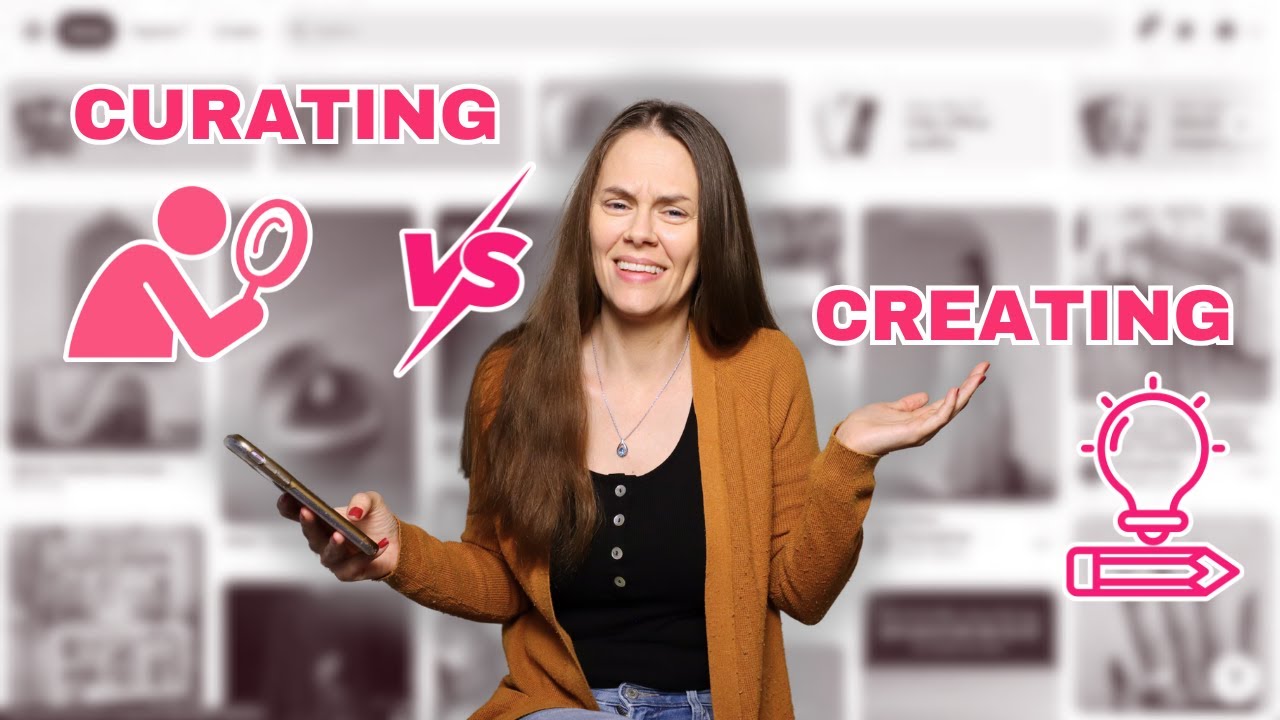
I know that it can feel weird to pin other people’s content, especially as a content creator or running your own e-commerce store with your own products. It feels like helping to drive traffic to other people’s websites, that it takes away everything from your brand.
Honestly, I get it. I get the fear. But when done right, curation can actually complement and enhance your brand, and does not need to compete with it. So, that’s what we’re going to dive into with today’s post.
Created vs Curated Content on Pinterest
Let’s define curation versus creation. Now, for the sake of today’s conversation, we’re going to stick to my terms and definitions. They may be slightly different from what you may find elsewhere, but in my audience I don’t want you confused.
Created Content
Creation is the making of content in whatever design software you use and publishing to Pinterest, then linking it back to your own website. That is my definition of creation or created content. It can be pins that go to:
- Blog posts
- YouTube videos
- Podcasts
- Products
- Your website pages
- Portfolio
- Affiliate links
You are intentionally creating Pinterest pins, putting them on Pinterest, and directing them back to your domain, your affiliate links, or whatever it is.
RELATED: Pinterest Best Practices to Get More Traffic & Sales
Curated Content
Now, curation on the other hand is a bit of a muddy topic in a lot of people’s content. Honestly, it’s a little confusing when other people talk about this, which is why I want to go with my super simplified definition.
In my opinion, curation is when you selectively curate high value, high quality content on Pinterest, or off Pinterest and then pinned to Pinterest. Curation is intentionally gathering existing content that aligns with your brand and your audience’s needs.
Here’s where it gets a little muddy. Sometimes Pinterest likes to say you can curate your own content to your boards. And in a way, yeah, you are doing that. But when I talk about curation, I specifically mean curating other people’s content to your own boards.
RELATED: Pinterest Mistakes Holding You Back From Success
Why Pinterest is a Curation-Based Platform
Pinterest is a curation-based platform too. Number one, Pinterest is not social media. It’s a visual search engine, and because of that, it is something that is super curated. Whether you are curating for yourself on a personal profile, or curating for your audience on your business profile, it just works. That’s why Pinterest was created to bring together all of these ideas in one place.
Number two, people like to collect really high value content, ideas and products, things that they want to come back to later. They’re planning their lives and they are trying to create something that is meaningful for them offline. But online, they’re curating all of these things on their own Pinterest boards in order to do just that.
RELATED: How Pinners Discover New Content on Pinterest
Boards Hold the Curation
When we create boards and we pin our own content to those boards, those pins are not floating in isolation. However, if you are just throwing a pin out here and there and you’re putting random pins on random boards that don’t have any relevance… That’s a big mistake, because then they’re definitely floating in isolation. We don’t want that; that’s like putting your kitchen dishes in random places around your house.
RELATED: What is Pinterest Relevancy & How the Pinterest Algorithm Works
Content Creator Example
Let’s move on to examples of a content creator, or a course seller specifically. So, let’s say you teach Productivity. You might create pins for your free guides, your courses, your blog posts, your podcast episodes, all about productivity and time management. But you could also curate pins inside of your topics on workspace setups.
Maybe you don’t want to create workspace setups in your own content, but you could curate other people’s content on that topic. Curate a variety of topics or resources that compliment your own content.
- Routines for work processes
- Morning routines
- Lunch break routines
- Content creation processes
- Time management rituals or hacks
- Tools that support productivity
- Products you suggest for time management
You could go and find those products and curate them to Pinterest boards, even if you don’t directly sell them yourself. Or other creators’ unique takes on using systems or routines that you personally enjoy yourself sharing those within your own boards.
RELATED: My Simple Content Strategy For Digital Products
Example from My Own Pinterest Strategy
Okay, I have an example for you. I’m obviously a Pinterest marketer. I run my YouTube channel. I have my education wing of my business. The I also have the agency wing of my business. I have a blog, but I don’t talk about blogging that much.
Of course, my business does have a blog, but I don’t talk about blogging because it’s not something that I’ve really ever wanted to get deep into. I’ve hit on it here and there, and I know it’s a supporting topic for my audience.
So I went to my colleague Jana Osovsk’s website and saved a whole bunch of her blog posts to my Blogging Tips board. Now, why would I do this? I am in her program and I know that my audience is going to get value out of her blogging course and high leverage content.

I want people to know about it. Her free content is so valuable. I wanted to curate content around blogging that I thought was going to help my audience. So, that’s what I did.
If it’s high quality, if I like the person, if I believe in what they’re doing, what they’re teaching, and how they’re teaching, then I will pin their stuff to my own boards because I don’t see them as competitors.
RELATED: How to Optimize Your Blog Content for Pinterest Users
E-commerce Example
Let’s move on to an e-commerce example. Let’s say you sell boho clothes: dresses, pants, tops, jackets, smocks, all of those kinds of things. But you do not sell belts, shoes, hats, pretty much any accessories. You just sell the clothing.
In this instance, you could create boards that support your boho fashion clothing vibe for your store, and you could curate boards around those accessories that are missing. It’s really that easy. It doesn’t have to be groundbreaking. But it really brings it full circle, though, right?
If you look at it from a holistic point of view, you kind of become the go-to guide for all things boho fashion, and almost like a stylist because you’re putting all of this together for your audience.
RELATED: Pinterest For E-Commerce: Pinning Tactics for Product Sellers
Monetizing Curated Content on Pinterest
Okay, let’s actually talk about how you can be monetizing curated content on Pinterest. If you want to go down the rabbit hole of finding affiliate links for all of the tools and resources that you love and that support your topic, you absolutely can.
You could curate those images, those products, to your Pinterest boards, and use your affiliate links as either product tags or the direct URL destination. This is totally optional, but totally possible too.

Affiliate Marketing on Pinterest: Deep Dive Training
In-depth insights for affiliate marketing on Pinterest that have been meticulously compiled, from years of proven success, with a diverse range of clients and businesses.
Learn how to drive affiliate sales, get more traffic for free, and promote affiliate products effectively on Pinterest.
You could even do this on your blog. You could put together some blogs where you showcase your beautiful boho clothing, and then you curate some affiliated products that pair really well—hats, shoes, belts, purses, jewelry, etc.
Curate some Pinterest pins around those things, pinning those images from their websites to your Pinterest boards, linking them to your affiliate links, and now you have a tiny little affiliate strategy going. But honestly, even without the affiliate strategy part of it, curating really does bring a holistic kind of whole picture view to your Pinterest account.
RELATED: How to Use Pinterest for Affiliate Marketing
How to Start Using Curated Content on Pinterest
So let’s cover what you need to do to start using curated content on Pinterest. You don’t need to reinvent the wheel. You don’t need to go and bust your entire Pinterest account apart and start creating new boards and doing all of this work that’s not really going to bring you money or ROI right now.
But the next time you sit down to work on your Pinterest account, if you notice some Pinterest pins on topics that are in alignment with yours, but don’t necessarily directly compete with what you’re doing, start curating some very simple things that are in alignment with our businesses.
Ask yourself: What does my audience search for that I don’t already provide? That’s your starting point. You then start building boards around those topics, adding some pins to them, and then over time you will start to notice more views.
RELATED Pinterest Tasks Not Worth Your Time + What to Do Instead
Analytics With Curated Content on Pinterest
You get trackable data with your curated content on Pinterest. Here’s the kicker around this whole thing: other people’s pins count in your overall monthly view count. So that little view count on the front end of your Pinterest profile that so many people are obsessed with, that number is impacted when you pin other people’s content.
There is actually a marker inside your analytics overview where you can include or separate your data to focus only your pins and/or remove all of the pins of other people, if you want. If you want to see a true number of your own views, you can definitely do that. But the numbers count even if you’ve pinned curated content on Pinterest.
RELATED: Pinterest Analytics: What to Do With Your Pinterest Data
Final Thoughts on Using Curated Content on Pinterest
When you start intentionally using curated content on Pinterest, your account begins to feel more complete, authoritative, and supportive to your audience. You’re no longer relying on constant content creation to stay visible. Instead, you’re building a resource-rich presence that positions you as a trusted guide in your niche, as someone who understands the bigger picture of what their audience truly needs.
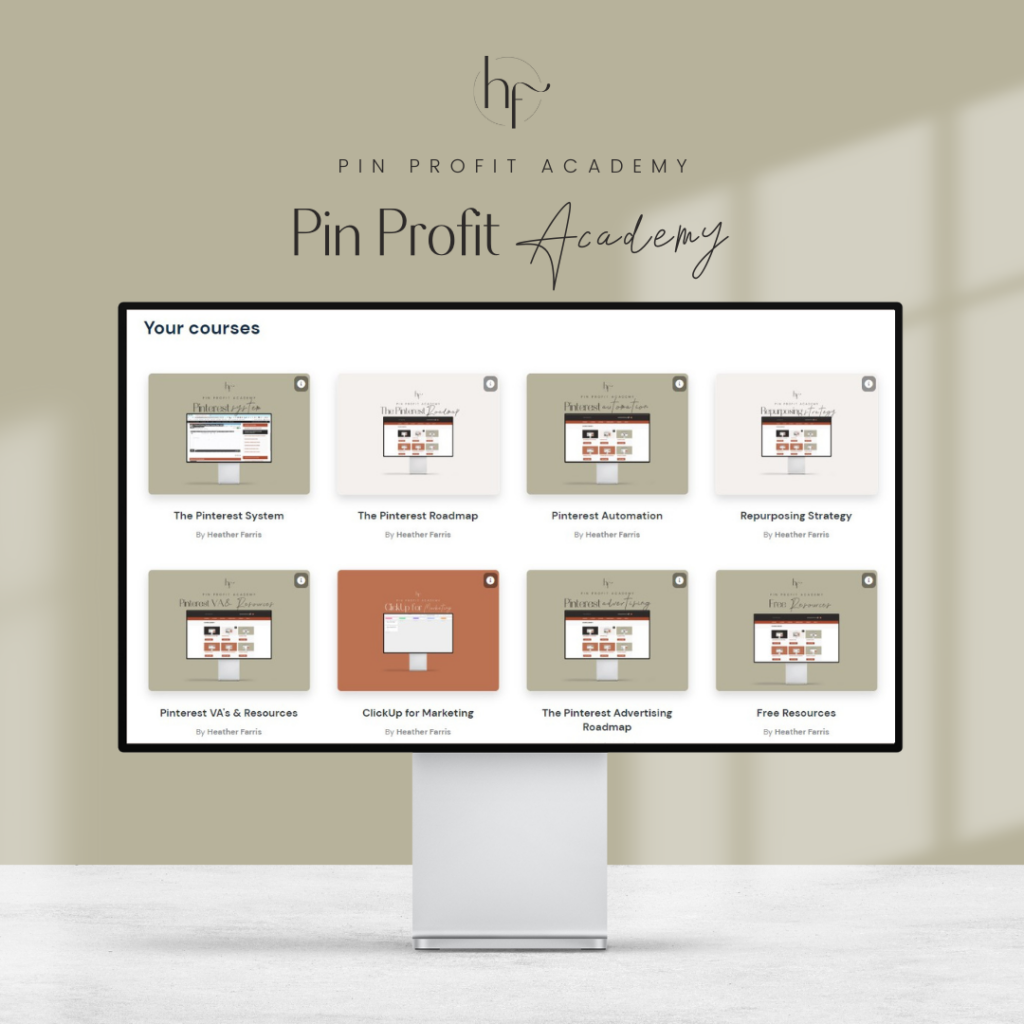
Curation and creation on Pinterest definitely results in a more fuller Pinterest marketing strategy. But if you want a complete Pinterest marketing strategy, with all of the different components and systems that go into one, come join Pin Profit Academy. You’ll also receive personalized help and direct access from me inside of our community. See you inside!
Pin Profit Academy
Marketing can be difficult and trying to figure it out on your own, especially with Pinterest, can be overwhelming.
I will show you how to double your traffic and sales without spending another minute on social media!
PPA is the only comprehensive membership program & community for creating, marketing & selling your products & services using Pinterest.
Pin it for later


Heather Farris went to school for accounting and worked for years in banking and finance. After finding all of that entirely too boring she started her first blog in her basement in August of 2016. She has started 3 blogs in the marketing, motherhood and travel niches and used Pinterest to grow them all. She quickly became the go-to Pinterest strategist in her peer circles and has been implementing strategies, driving traffic and sales through organic and paid tactics for her clients. On this blog and her YouTube channel, as a renowned Pinterest marketing expert, she educates the public about clear and transparent marketing strategies to help them to grow on Pinterest and in other places online. She created Pin Profit Academy and helps small business owners just like you to master their Pinterest marketing strategy. Heather is now a Pinterest Educator, one of the very few sponsored by Pinterest.